Interactive Gravel Explorer
Click any type to see details & photos
One of the most common questions we get is: “How much does 1 ton of gravel cover?” It is not a simple one-size-fits-all answer — the coverage depends heavily on the depth you are applying and the type of gravel you are using.
In this guide, we will give you exact coverage numbers at every common depth, a comparison by gravel type, and all the information you need to confidently order the right amount — without expensive waste or frustrating shortfalls.
Quick Answer: 1 ton of gravel covers approximately 100 sq ft at 2 inches deep, 80 sq ft at 2.5 inches, or 65 sq ft at 3 inches deep for standard crushed stone or pea gravel.
The Short Answer: 1 Ton Coverage by Depth
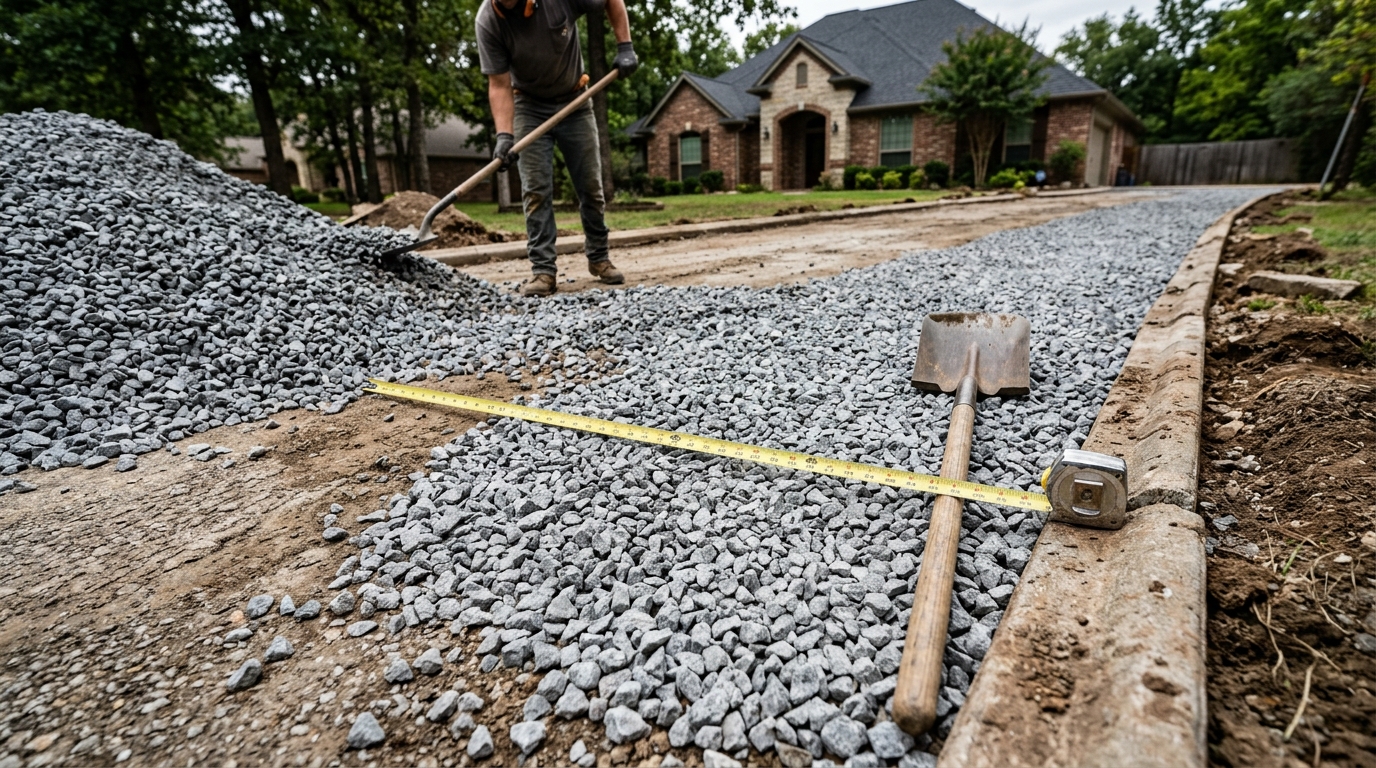
Here is a quick-reference table for coverage of 1 ton of gravel at different depths:
| Depth | Coverage (sq ft) | Best For |
|---|---|---|
| 1 inch | ~160–200 sq ft | Light top-dressing, decorative refresh |
| 1.5 inches | ~120–160 sq ft | Garden paths (light use) |
| 2 inches | ~100–130 sq ft | Patios, garden paths, flower beds |
| 2.5 inches | ~80–100 sq ft | Walkways, patio resurfacing |
| 3 inches | ~65–80 sq ft | Standard driveway top layer |
| 4 inches | ~50–65 sq ft | Driveways (base layer) |
| 6 inches | ~30–40 sq ft | Driveways (heavy-duty), French drains |
| 12 inches | ~15–20 sq ft | Deep drainage trenches, French drains |
Note: These ranges reflect the density variation between gravel types. Heavier materials (granite, limestone) cover less area per ton; lighter materials (lava rock, pea gravel) cover slightly more.
Why Does Coverage Vary? The Math Behind It
Understanding the calculation prevents costly mistakes. Here is the practical formula:
Cubic yards from tons = Tons divided by 1.4 Coverage at 1 inch depth (sq ft) = Cubic yards multiplied by 324
| Conversion | Value |
|---|---|
| 1 ton to cubic yards | 1 ton / 1.4 = ~0.71 cubic yards |
| 0.71 cu yd at 1 inch depth | 0.71 x 324 = ~230 sq ft |
| 0.71 cu yd at 2 inch depth | 0.71 x 162 = ~115 sq ft |
| 0.71 cu yd at 3 inch depth | 0.71 x 108 = ~77 sq ft |
The 1.4 conversion factor (tons to cubic yards) is the industry standard for crushed stone and pea gravel. Denser materials like river rock use approximately 1.5, and lighter materials like lava rock use 1.0–1.2.
Coverage by Gravel Type
Different gravel types have different densities, which directly affects how far 1 ton will go:
| Gravel Type | Density (lbs/cu ft) | 1 Ton at 2 inches | 1 Ton at 3 inches |
|---|---|---|---|
| Crushed Stone #57 | ~100 | ~100 sq ft | ~67 sq ft |
| Pea Gravel | ~96 | ~104 sq ft | ~69 sq ft |
| Limestone | ~100 | ~100 sq ft | ~67 sq ft |
| River Rock | ~105 | ~95 sq ft | ~63 sq ft |
| Decomposed Granite | ~90 | ~111 sq ft | ~74 sq ft |
| Lava Rock | ~60 | ~167 sq ft | ~111 sq ft |
| Marble Chips | ~95 | ~105 sq ft | ~70 sq ft |
| Crusher Run | ~110 | ~91 sq ft | ~61 sq ft |
Key Takeaways:
- Lava rock covers the most area per ton — it is very lightweight and porous
- Crusher run and river rock cover the least because they are the densest
- Most standard gravels (crushed stone, pea gravel, limestone) cover similar areas per ton
Depth Guide: How Deep Should Your Gravel Be?
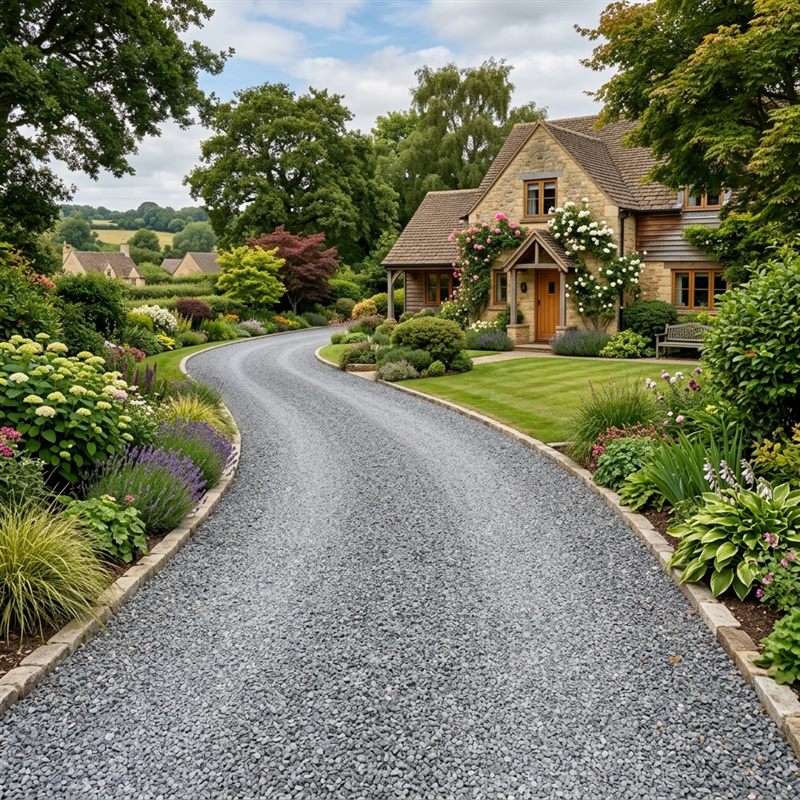
Choosing the right depth matters as much as knowing coverage. Too little and gravel migrates and wears away quickly. Too much and you are overspending.
Decorative and Garden Applications: 1 to 2 Inches
- Flower beds and borders: 1–2 inches for weed suppression and aesthetics
- Around trees and shrubs: 2 inches — avoid piling against the trunk
- Decorative top-dressing on existing gravel: 1 inch refresh layer
Pathways and Patios: 2 to 3 Inches
- Garden paths: 2–3 inches is enough to walk comfortably without sinking
- Pea gravel patios: 2–3 inches on a compacted base
- Between stepping stones: 2 inches to hold stones in place
Driveways: 3 to 6 Inches
- Residential driveway top layer: 3–4 inches of #57 crushed stone
- Heavy-use or rural driveways: 4–6 inches top layer
- Full driveway system: 4–6 inches crusher run base plus 3–4 inches top layer equals 8–12 inches total
Drainage Applications: 6 to 12 Inches
- French drains: Fill the trench completely, typically 12–24 inches deep
- Dry wells: Fill entirely with clean washed crushed stone
- Pipe bedding: Minimum 6 inches below and around the pipe
Real-World Project Examples
Here are practical calculations for common project sizes:
Example 1: Small Patio (10 x 12 ft = 120 sq ft at 2 inch depth)
- Cubic yards needed: 120 x 2 / 324 = 0.74 cu yd
- Tons needed: 0.74 x 1.4 = ~1.04 tons
- Order: 1 ton plus 10% buffer = 1.1 tons — round up to 1.5 ton minimum at most suppliers
Example 2: Standard Driveway (50 x 12 ft = 600 sq ft at 3 inch depth)
- Cubic yards needed: 600 x 3 / 324 = 5.56 cu yd
- Tons needed: 5.56 x 1.4 = ~7.78 tons
- Order: 7.78 plus 10% buffer = ~8.5 tons
Example 3: Garden Path (40 x 3 ft = 120 sq ft at 2 inch depth)
- Cubic yards needed: 120 x 2 / 324 = 0.74 cu yd
- Tons needed: 0.74 x 1.4 = ~1.04 tons
- Order: 1 ton is just right
Example 4: Flower Bed Border (200 sq ft at 1.5 inch depth)
- Cubic yards needed: 200 x 1.5 / 324 = 0.93 cu yd
- Tons needed: 0.93 x 1.4 = ~1.3 tons
- Order: 1.5 tons including a buffer
Coverage Estimator
📐 How Many Tons Do I Need?
Enter your project dimensions and desired depth:
1 Ton of Gravel: What Does It Look Like?
It helps to visualize what 1 ton of gravel actually is before you order:
- Weight: 2,000 lbs — about the weight of a small car
- Volume: Roughly 0.71 cubic yards — approximately a 2.5 x 2.5 x 2.5 ft cube
- Pickup truck: Fills the bed of a standard half-ton pickup truck to the brim
- Wheelbarrow loads: Approximately 14–18 standard wheelbarrow loads
- Coverage: Roughly a 10 x 10 ft patio covered to 2 inches deep
That one pickup truck bed of gravel will cover a 10 x 10 foot space to 2 inches. Keep that mental image in mind when planning your order.
How to Order Gravel: Practical Tips
Always Add a 10% Buffer
Gravel settles and compacts after installation by 5–10%. Always order 10% more than your calculated amount to avoid a costly second delivery.
Minimum Delivery Quantities
Most bulk suppliers have minimums:
- Pickup yourself: 1–2 tons — you load or hire a loader
- Small delivery: 3–5 ton minimum at most suppliers
- Full truck load: 20–25 tons — the most economical per-ton price
If your project needs less than 3 tons, consider bagged gravel from a home improvement store or picking up loose material with a rented truck.
Measure Twice, Order Once
Returned gravel deliveries are nearly impossible and very expensive. Double-check your measurements before placing your order.
Common Ordering Mistakes
Forgetting Compaction Factor
Crusher run and decomposed granite compact by 15–25% after rain and traffic. Add this to your buffer for compactable materials.
Confusing Weight and Volume
Gravel is sold by the ton (weight) but coverage is calculated by volume (cubic yards). Always convert: 1 ton = approximately 0.71 cubic yards for standard gravels.
Measuring Wrong Depth for Top-Ups
If you need 3 inches total but already have 1 inch, you only need to add 2 inches — not 3. Always measure your existing depth before ordering a refresh.
Coverage Reference Table
| Area Size | 2 inch depth | 3 inch depth | 4 inch depth |
|---|---|---|---|
| 50 sq ft | 0.5 tons | 0.7 tons | 0.9 tons |
| 100 sq ft | 1.0 ton | 1.3 tons | 1.8 tons |
| 200 sq ft | 1.9 tons | 2.6 tons | 3.5 tons |
| 400 sq ft | 3.8 tons | 5.2 tons | 6.9 tons |
| 500 sq ft | 4.7 tons | 6.4 tons | 8.6 tons |
| 1,000 sq ft | 9.4 tons | 12.9 tons | 17.1 tons |
| 2,000 sq ft | 18.8 tons | 25.7 tons | 34.3 tons |
Frequently Asked Questions
How many square feet does 1 ton of pea gravel cover?
At 2 inches deep, 1 ton of pea gravel covers approximately 100–110 sq ft. At 3 inches, coverage drops to about 65–75 sq ft.
How many square feet does 1 ton of crushed stone cover?
1 ton of #57 crushed stone at 2 inches deep covers approximately 95–105 sq ft. At 3 inches, expect 65–70 sq ft of coverage.
How much does 1 ton of gravel cover for a driveway?
For a 3-inch driveway top layer, 1 ton covers about 65–80 sq ft. Most standard residential driveways (50 ft x 12 ft) need 7–9 tons for the top layer alone.
Is 1 ton of gravel the same as 1 cubic yard?
No. 1 ton is a unit of weight (2,000 lbs), while 1 cubic yard is a unit of volume (27 cubic feet). For most standard gravels, 1 ton equals approximately 0.71 cubic yards.
How many bags of gravel equal 1 ton?
Standard bagged gravel is sold in 0.5 cubic foot bags. One ton equals approximately 19 cubic feet, so you would need 38–40 bags to equal 1 ton. Bagged gravel is far more expensive per ton but practical for small projects.
How many tons of gravel for a 20x20 patio?
A 20 x 20 ft patio (400 sq ft) at 2 inches deep needs approximately 3.7–3.9 tons. At 3 inches deep, plan for 5.5–5.8 tons. Order 4 tons for 2 inches or 6 tons for 3 inches to include your buffer.
Summary
The coverage of 1 ton of gravel comes down to two key variables: depth and gravel type. The general rule of thumb is:
1 ton of gravel covers approximately 100 sq ft at 2 inches deep for most standard materials.
For every extra inch of depth, coverage drops by roughly 25–33%. Use the tables in this guide, add your 10% buffer, and you will order the right amount every time.
💡 Need an exact calculation? Use our free Gravel Calculator — enter your length, width, and depth to get precise tonnage, cubic yards, and cost estimates in seconds.
Found this helpful? Share it!
Ready to calculate your gravel?
Use our free calculator to get instant volume, weight & cost estimates.
Try the Free Calculator →