Interactive Gravel Explorer
Click any type to see details & photos
Planning a gravel driveway? The most common question we get is: “How much gravel do I actually need?”
Get it wrong and you’re either wasting money on excess material or making a second run to the supplier. Get it right and your driveway project runs smoothly from start to finish.
In this guide, we’ll walk you through the exact formula, show you real-world examples for common driveway sizes, explain how depth affects your calculation, and tell you which gravel type to use — so you can order with confidence.
🧮 Skip straight to the math? Use our free Gravel Driveway Calculator to get your exact tonnage and cost in under 30 seconds.
The Short Answer: Gravel Formula for Driveways
To calculate how much gravel you need for a driveway, use this formula:
Cubic Yards = (Length ft × Width ft × Depth in) ÷ 324
Tons = Cubic Yards × 1.4
That’s it. Two steps. Let’s break down each part.
Step 1 — Measure Your Driveway
You need three measurements:
Length
Measure the full length of your driveway from the road to where it ends (garage, turnaround, etc.). If your driveway has curves, measure along the center line.
Width
Measure the width at its widest point. A standard single-car driveway is 10–12 feet wide. A double-car driveway is typically 18–24 feet wide.
Depth
This is the most important variable and depends on what you’re building:
| Application | Recommended Depth |
|---|---|
| Light residential (single car) | 4 inches |
| Standard driveway (1–2 cars) | 4–6 inches |
| Heavy use / truck traffic | 6–8 inches |
| Full layered system (base + top) | 10–12 inches total |
| Driveway replenishment (top-up) | 2–3 inches |
Pro Tip: For a new driveway from scratch, plan for a 3-layer system — 4–6” crusher run base, 3–4” #57 mid-layer, 2” decorative top. Total: 9–12 inches. Order each layer separately for best results.
Step 2 — Calculate Cubic Yards
Once you have your measurements:
Cubic Yards = (Length × Width × Depth in inches) ÷ 324
The number 324 comes from converting: 1 cubic yard = 3 ft × 3 ft × 3 ft = 27 cubic feet. Since depth is in inches, we convert: 27 × 12 = 324.
Example Calculations
Small Driveway (50 ft × 10 ft × 4 inches deep)
(50 × 10 × 4) ÷ 324 = 2,000 ÷ 324 = **6.17 cubic yards**
Standard Single-Car Driveway (100 ft × 12 ft × 4 inches)
(100 × 12 × 4) ÷ 324 = 4,800 ÷ 324 = **14.8 cubic yards**
Double-Car Driveway (100 ft × 20 ft × 6 inches)
(100 × 20 × 6) ÷ 324 = 12,000 ÷ 324 = **37 cubic yards**
Long Rural Driveway (300 ft × 12 ft × 6 inches)
(300 × 12 × 6) ÷ 324 = 21,600 ÷ 324 = **66.7 cubic yards**
Step 3 — Convert to Tons
Gravel is sold by the ton at most quarries and landscape suppliers. The conversion factor depends on the gravel type, but 1.4 tons per cubic yard is the standard for crushed stone and most common driveway gravels.
Tons = Cubic Yards × 1.4
| Gravel Type | Tons per Cubic Yard |
|---|---|
| Crushed limestone | 1.35 – 1.45 |
| Crushed granite | 1.45 – 1.55 |
| Pea gravel | 1.30 – 1.40 |
| Crusher run | 1.40 – 1.50 |
| River rock | 1.35 – 1.50 |
Tonnage Examples
| Driveway Size | Depth | Cubic Yards | Tons Needed |
|---|---|---|---|
| 50 ft × 10 ft | 4” | 6.2 | 8.6 tons |
| 100 ft × 12 ft | 4” | 14.8 | 20.7 tons |
| 100 ft × 20 ft | 6” | 37.0 | 51.8 tons |
| 200 ft × 12 ft | 6” | 44.4 | 62.2 tons |
| 300 ft × 12 ft | 6” | 66.7 | 93.4 tons |
Always add 10% extra to account for compaction, waste, and uneven subgrade. Multiply your final tons figure by 1.10.
Common Driveway Sizes — Ready-Made Estimates
Standard Single-Car Driveway
- Size: 12 ft wide × 50–150 ft long
- Depth: 4–6 inches
- Gravel Needed: 10–45 tons (depending on length)
- Estimated Cost: $200–$1,800
Standard Double-Car Driveway
- Size: 20–24 ft wide × 50–100 ft long
- Depth: 4–6 inches
- Gravel Needed: 25–90 tons
- Estimated Cost: $500–$3,600
Long Country/Rural Driveway
- Size: 12 ft wide × 300–1,000 ft long
- Depth: 6 inches
- Gravel Needed: 93–310 tons
- Estimated Cost: $2,800–$15,000+
How Deep Should Gravel Be for a Driveway?
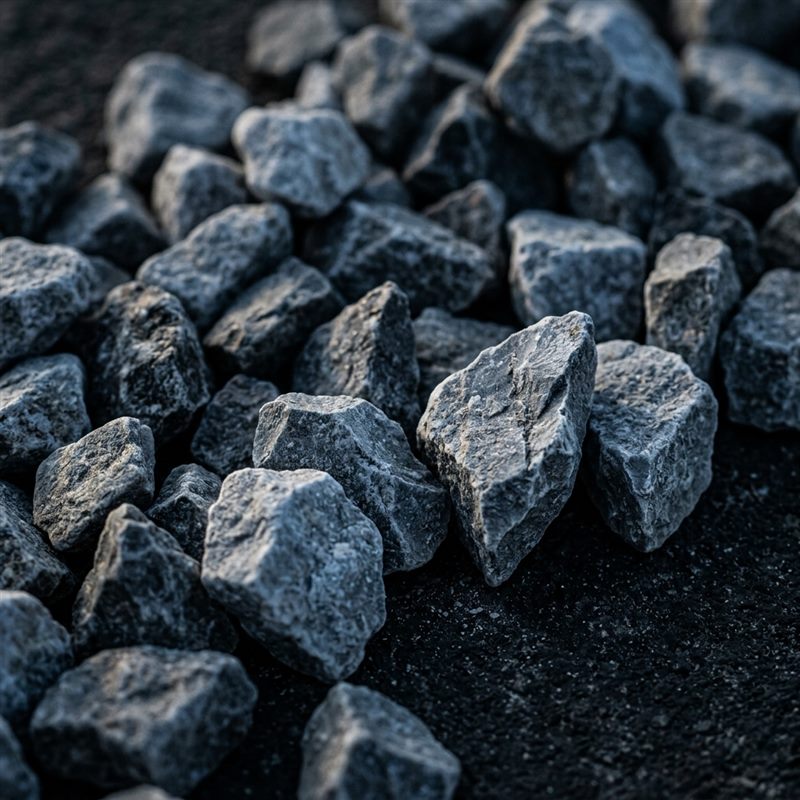
Depth is the most common mistake homeowners make. Too shallow and the gravel sinks into the soil, gets muddy, and disappears within a season. Too deep and you’re wasting money.
Recommended Depths by Situation
New driveway on firm, well-draining soil:
- Single layer: 4–6 inches of #57 crushed stone
- Best practice: 4” crusher run base + 3” #57 + 2” decorative = 9 inches total
New driveway on soft, clay, or wet soil:
- Use a geotextile fabric layer first
- 6–8 inches of crushed stone (start with crusher run base)
- May need a sub-base of larger stones (#3 or #4) first
Replenishing an existing driveway:
- 2–3 inches is usually sufficient to restore depth and fill ruts
High-traffic or commercial use:
- Minimum 6 inches, ideally 8–10 inches
- Always use a proper base layer
The 3-Layer Driveway System (The Right Way)
For a driveway that lasts 10–15+ years, professionals use a 3-layer approach:
Layer 1: Base — Crusher Run (4–6 inches)
Also called quarry process or QP. This is a blend of crushed stone and stone dust that compacts into a rock-solid foundation. It’s the most important layer.
Why it works: The stone dust fills all the gaps, creating zero voids. When compacted with a plate compactor, it becomes nearly as solid as pavement.
Layer 2: Mid-Layer — #57 Crushed Stone (3–4 inches)
The workhorse layer. Angular edges interlock under vehicle weight. This is where most of the structural strength lives.
Why it works: The ¾”–1” angular stones create excellent drainage through the voids while interlocking to prevent rutting.
Layer 3: Top Dressing — Decorative Gravel (1–2 inches)
This is the layer you see and drive on. Options include #57 crushed stone, pea gravel (not ideal for traffic), limestone, or granite chips.
Why it matters: Replenished every 1–3 years to maintain appearance and depth.
How Much to Order Per Layer
For a 100 ft × 12 ft driveway:
| Layer | Material | Depth | Cubic Yards | Tons |
|---|---|---|---|---|
| Base | Crusher run | 5” | 18.5 | 25.9 |
| Mid | #57 crushed stone | 4” | 14.8 | 20.7 |
| Top | Decorative | 2” | 7.4 | 10.4 |
| Total | 11” | 40.7 | 57 |
What Type of Gravel Is Best for Driveways?
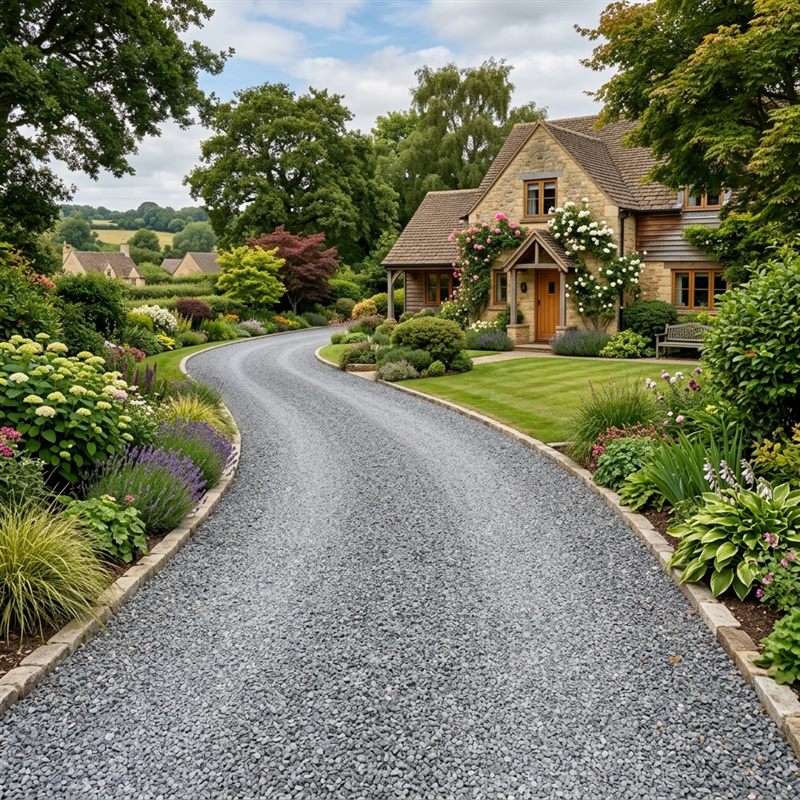
Not all gravel is equal for driveways. Here’s what professionals recommend:
🥇 Best: Crushed Stone #57 (¾”–1”)
The gold standard for driveway surfaces. Angular shape interlocks. Available everywhere. Affordable.
🥈 Runner-Up: Crusher Run / Quarry Process
Best for base layers. Mix of crushed stone and fines = maximum compaction.
🥉 Good: Crushed Limestone
Widely available, affordable, compacts well. Popular in the Midwest and South.
❌ Avoid: Pea Gravel (for driveways)
Smooth round stones = no interlocking = constant migration = frustrating to maintain.
❌ Avoid: River Rock (for driveways)
Beautiful but functionally terrible — rolls under tires. Decorative use only.
How to Calculate Gravel Cost
The total cost of a gravel driveway depends on:
- Material cost — typically $20–$50 per ton depending on type
- Delivery fee — $50–$150+ per truckload (varies by distance)
- Equipment rental — plate compactor $50–$100/day, excavator $300–$600/day
- Labor — $20–$50/hour if hiring help
Cost Estimate Formula
Total Cost = (Tons × Price per ton) + Delivery + Equipment
Real-World Cost Examples
| Driveway | Tons Needed | Material | Delivery | Equipment | Total Est. |
|---|---|---|---|---|---|
| 50ft × 10ft × 4” | 8.6 | $215–$430 | $75 | $50 (rental) | $340–$555 |
| 100ft × 12ft × 4” | 20.7 | $515–$1,035 | $150 | $100 | $765–$1,285 |
| 100ft × 20ft × 6” | 51.8 | $1,295–$2,590 | $300 | $200 | $1,795–$3,090 |
| 300ft × 12ft × 6” | 93.4 | $2,335–$4,670 | $500 | $500 | $3,335–$5,670 |
💡 Save money: Order all your gravel at once — most suppliers offer bulk discounts for large orders and charge a flat delivery fee per truck regardless of tonnage (up to the truck’s limit, typically 20–25 tons).
Interactive Driveway Gravel Estimator
Use the estimator below to get your personalized estimate, or try our full-featured Gravel Driveway Calculator for complete cost breakdowns.
🧮 Quick Driveway Estimator
How Many Tons Per Truckload?
When ordering gravel for delivery, you need to know how many truckloads you’ll need:
| Truck Type | Capacity |
|---|---|
| Standard dump truck | 10–14 tons |
| Tri-axle dump truck | 14–16 tons |
| Semi / end dump | 20–26 tons |
| Pickup truck (DIY) | 0.5–1 ton (bag or small load) |
Example: You need 57 tons for your driveway → 57 ÷ 14 = ~4.1 truckloads → order 4–5 truckloads.
Call your supplier and ask about their truck capacity and pricing structure. Many charge a flat delivery fee per trip, so it’s more economical to order larger quantities per trip.
Step-by-Step: How to Install a Gravel Driveway
What You’ll Need
- Gravel (all layers)
- Landscape fabric / geotextile
- Driveway edging (optional but recommended)
- Plate compactor (rental ~$75/day)
- Rake and shovel
- Garden hose or water truck (for settling)
Installation Steps
1. Mark the Driveway Boundaries Use wooden stakes and string lines to mark the edges. Spray paint can also work for curved driveways.
2. Excavate to Depth Dig down 10–12 inches for a full 3-layer system, or 4–6 inches for a single-layer installation. Remove all organic material — roots, topsoil, and grass.
3. Grade the Subgrade Slope the surface very slightly (1–2%) toward the edges for water runoff. A flat or inward-sloping base will collect water and cause problems.
4. Compact the Subgrade Run a plate compactor over the bare soil in overlapping passes. This prevents the base gravel from sinking over time.
5. Install Landscape Fabric (Optional) A geotextile fabric over the compacted soil prevents the gravel from mixing with the dirt below. Not always necessary with a thick base layer, but recommended for soft or clay soils.
6. Add and Compact the Base Layer Spread crusher run in 2–3 inch lifts, compacting each lift before adding more. Wet it slightly before compacting for best results.
7. Add the Mid-Layer Spread #57 crushed stone, rake level, and compact. Check that your drainage slope is maintained.
8. Add the Top Layer Spread your final decorative gravel layer (1–2 inches). Rake smooth. Avoid over-compacting the top layer.
9. Install Edging Steel, aluminum, or timber edging along the sides keeps gravel contained and the edges clean. This step dramatically reduces ongoing maintenance.
10. First Rain Test After the first significant rain, inspect for pooling water, rutting, or low spots. Add extra gravel to any problem areas.
Gravel Driveway Maintenance
A well-built gravel driveway is low maintenance, but not zero maintenance:
Yearly Tasks
- Spring: Rake and redistribute gravel that has migrated to edges. Fill ruts.
- Summer: Grade periodically with a rake or landscape rake on a riding mower.
- Fall: Check drainage before heavy rain season.
Every 3–5 Years
- Top-dressing: Add 1–2 inches of fresh gravel to restore depth
- Amount needed: Use the formula at 2” depth for your driveway dimensions
When to Worry
- Potholes forming: Subgrade issue — may need to remove and recompact base
- Washboard surface: Normal with traffic. Grade with a box blade or road grader.
- Mud mixing through gravel: Subgrade failure — add geotextile and new base material
Frequently Asked Questions
How many yards of gravel do I need for a 200-foot driveway?
For a 200 ft × 12 ft driveway at 4 inches deep:
(200 × 12 × 4) ÷ 324 = 29.6 cubic yards = ~41.5 tons
At 6 inches: (200 × 12 × 6) ÷ 324 = 44.4 cubic yards = ~62 tons
How many tons of gravel do I need for a 1/4 mile driveway?
A quarter mile = 1,320 feet. For a 1,320 ft × 12 ft driveway at 6 inches deep:
(1,320 × 12 × 6) ÷ 324 = 293 cubic yards = ~410 tons
That’s approximately 20–25 truckloads. At $30/ton delivered, expect $12,000–$15,000 in materials alone.
How deep should a gravel driveway be?
The standard is 4 inches minimum for a single-layer driveway on firm, well-draining soil. For the best long-term results, use a 3-layer system totaling 10–12 inches (4–6” base + 3–4” mid + 2” top).
How much does a ton of gravel cover?
One ton of gravel covers approximately:
- At 2 inches deep: ~100 square feet
- At 4 inches deep: ~50 square feet
- At 6 inches deep: ~33 square feet
Can I use any gravel for a driveway?
No. Crushed stone with angular edges (such as #57 crushed limestone or granite) is essential. Avoid pea gravel and river rock — their smooth, round shape prevents compaction and they scatter under tire pressure.
Should I use landscape fabric under a gravel driveway?
For driveways on clay soil or in wet climates, yes — a heavy-duty woven geotextile fabric (not the lightweight garden variety) prevents gravel from sinking into the soil and separates layers. On sandy, well-draining soil it’s optional.
How long does a gravel driveway last?
With proper installation and periodic maintenance (raking and top-dressing every few years), a gravel driveway can last indefinitely. The base layer essentially never needs replacement. Only the top layers wear down and need replenishing.
How do I prevent gravel from spreading into my lawn?
Install rigid edging along both sides of the driveway — steel, aluminum, or heavy plastic driveway edging. Drive it flush with or just below the gravel surface. This single step dramatically reduces gravel migration.
Summary: Quick Reference
| Task | Formula |
|---|---|
| Cubic yards | (L × W × D inches) ÷ 324 |
| Tons needed | Cubic yards × 1.4 |
| With 10% buffer | Tons × 1.10 |
| Cost estimate | Tons × price per ton + delivery |
Depth cheat sheet:
- Replenish: 2” → ~0.006 cubic yards per sq ft
- Light use: 4” → ~0.012 cubic yards per sq ft
- Standard: 6” → ~0.019 cubic yards per sq ft
- Heavy use: 8” → ~0.025 cubic yards per sq ft
Ready to get your exact gravel estimate? Our Gravel Driveway Calculator handles all the math automatically — just enter your dimensions and get instant cubic yards, tons, and estimated cost. It even accounts for waste and multiple gravel types.
Found this helpful? Share it!
Ready to calculate your gravel?
Use our free calculator to get instant volume, weight & cost estimates.
Try the Free Calculator →