Whether you are running a water line across your yard, installing a drainage channel along a property boundary, or bedding a sewer pipe 4 feet underground — every trench or ditch project needs gravel, and calculating the right amount upfront saves time, money, and a second trip to the quarry.
This guide covers everything: the formula for calculating gravel volume in long, narrow areas, common trench dimensions by project type, the right gravel for drainage ditches versus utility bedding, and practical backfilling tips from the pipe zone up to finished grade.
Quick Answer: A typical utility trench (12 inches wide x 24 inches deep x 100 feet long) requires approximately 11 to 12 tons of gravel for full fill, or 4 to 5 tons for pipe bedding only (6 inches below + 6 inches above a 4-inch pipe).
Common Trench Dimensions by Application
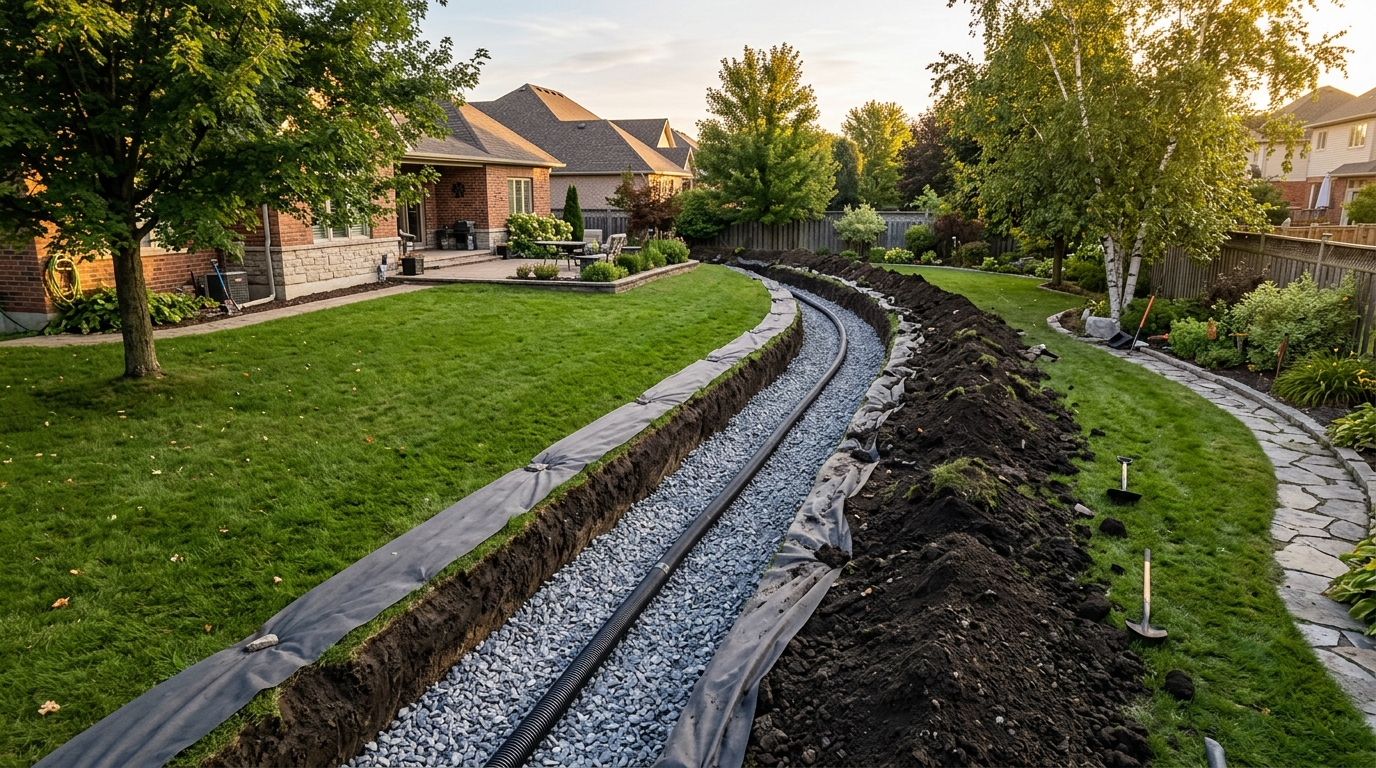
Not all trenches are created equal. A shallow irrigation channel and a deep utility trench for a gas line have completely different geometry and completely different gravel requirements. Use this reference table to find dimensions typical for your project type:
| Trench / Ditch Type | Typical Width | Typical Depth | Common Gravel Depth |
|---|---|---|---|
| Surface drainage ditch | 12-24 in | 12-18 in | Full depth fill |
| Irrigation channel | 6-12 in | 12-18 in | Full depth fill |
| 4-inch drain pipe (residential) | 12-18 in | 24-36 in | 12-18 in bedding zone |
| 6-inch sewer lateral | 18-24 in | 36-60 in | 12-18 in bedding zone |
| Water supply line (residential) | 12-18 in | 36-48 in | 4-6 in bedding only |
| Electrical conduit trench | 12-18 in | 18-24 in | 4-6 in sand/fine gravel |
| Gas line trench | 12-18 in | 24-36 in | 4-6 in sand bedding |
| Foundation perimeter drain | 12-18 in | 24-48 in | Full depth fill |
| Dry creek / decorative ditch | 18-36 in | 6-12 in | Full depth fill |
Key distinction: A trench is narrow and deep (for utilities and buried pipe). A ditch is wider and shallower (for surface water collection and conveyance). The volume formula is the same but gravel type and depth requirements differ significantly.
Calculating Gravel Volume for Long, Narrow Areas
A trench or ditch is essentially a rectangular prism. The calculation is straightforward:
Step 1 - Calculate cubic feet:
Volume (ft3) = Length (ft) x Width (ft) x Depth of gravel fill (ft)
Step 2 - Convert to cubic yards:
Cubic Yards = Volume (ft3) / 27
Step 3 - Convert to tons:
Tons = Cubic Yards x 1.4 (1.4 is the typical weight factor for crushed stone; use 1.2 for pea gravel or 1.5 for dense-grade aggregate)
Combined shortcut formula:
Tons = (Length ft x Width ft x Depth ft) / 19.3
Worked Example: Drainage Ditch
You have a drainage ditch that is 80 feet long, 18 inches (1.5 ft) wide, and you need 12 inches (1 ft) of gravel fill:
- Volume: 80 x 1.5 x 1.0 = 120 cubic feet
- Cubic yards: 120 / 27 = 4.44 cubic yards
- Tons: 4.44 x 1.4 = ~6.2 tons
- Order: 7 tons (includes 10-12% buffer for settling and waste)
Worked Example: Utility Trench (Pipe Bedding Only)
A 100-foot water line trench is 16 inches (1.33 ft) wide and you need 12 inches (1 ft) of gravel (6 inches below + 6 inches above the pipe):
- Volume: 100 x 1.33 x 1.0 = 133 cubic feet
- Cubic yards: 133 / 27 = 4.93 cubic yards
- Tons: 4.93 x 1.4 = ~6.9 tons
- Order: 7.5 tons
Trench Gravel Calculator
Gravel Calculator for Trench and Ditch
Enter your trench or ditch dimensions to get cubic yards, tons, and estimated bags needed:
Quick-Reference: Gravel Needed by Trench Length
Drainage Ditch (18” wide x 12” deep)
| Ditch Length | Cubic Yards | Tons | Order (with buffer) |
|---|---|---|---|
| 25 ft | 1.04 yd3 | 1.5 tons | 1.7 tons |
| 50 ft | 2.08 yd3 | 2.9 tons | 3.2 tons |
| 75 ft | 3.13 yd3 | 4.4 tons | 4.8 tons |
| 100 ft | 4.17 yd3 | 5.8 tons | 6.4 tons |
| 150 ft | 6.25 yd3 | 8.75 tons | 9.6 tons |
Utility Trench Bedding (16” wide x 12” gravel zone)
| Trench Length | Cubic Yards | Tons | Order (with buffer) |
|---|---|---|---|
| 25 ft | 1.23 yd3 | 1.7 tons | 1.9 tons |
| 50 ft | 2.47 yd3 | 3.5 tons | 3.8 tons |
| 100 ft | 4.94 yd3 | 6.9 tons | 7.6 tons |
| 150 ft | 7.41 yd3 | 10.4 tons | 11.4 tons |
| 200 ft | 9.88 yd3 | 13.8 tons | 15.2 tons |
Always add 10% to your calculated amount to account for material compaction, spills, and uneven trench geometry.
Best Gravel Type: Drainage Ditch vs. Utility Bedding
Choosing the wrong gravel is the most expensive mistake in any trench project. The right gravel depends entirely on what the trench is doing.
For Drainage Ditches and Channels
The goal is maximum water flow through the gravel. You need void space and that means clean, angular stone with no fines.
| Gravel | Size | Best Use |
|---|---|---|
| #57 Crushed Stone | 3/4”-1” | Standard drainage ditch, dry creek |
| #4 Stone | 1”-1.5” | Heavy runoff, high-flow channels |
| #89 Stone | 3/8”-1/2” | Narrow channels, decorative ditches |
| Washed River Rock | 1”-3” | Decorative dry creek beds |
| Crusher Run | Mixed | Never for drainage - clogs immediately |
| Pea Gravel | 3/8” | Not recommended for high-flow drainage |
Rule of thumb for drainage: If you can see dust or fines in the gravel pile, do not use it for drainage.
For Utility Trench Bedding (Pipe Zone)
The goal is uniform, stable support for the pipe. Pipe type determines gravel size:
| Pipe Type | Recommended Bedding | Size |
|---|---|---|
| PVC / HDPE pipe | Pea gravel or #89 stone | 3/8”-1/2” |
| Concrete / Clay pipe | #57 crushed stone | 3/4”-1” |
| Ductile iron / steel | #57 or clean sand | 3/4”-1” or fine |
| Electrical conduit | Washed sand or #89 stone | Fine-3/8” |
| Gas line | Washed sand | Fine |
Utility codes matter: OSHA 29 CFR 1926.650 and local utility codes (AWWA, ASTM) often specify minimum bedding material and compaction requirements. Always check local standards for municipal or engineered utility work.
Backfilling a Trench: Zone by Zone
A utility trench is filled in distinct zones. Each zone has different gravel or soil requirements.
Zone 1: Initial Bedding (Below Pipe)
Depth: 4-6 inches below pipe | Material: Clean pea gravel or #89 stone | Compaction: None - hand-grade only
Zone 2: Pipe Zone (Around Pipe)
Depth: From bedding up to 6-12 inches above pipe crown | Material: Same clean gravel, no fines | Compaction: None - no mechanical compaction in this zone
Zone 3: Lower Haunch to Springline
Depth: Sides of pipe | Material: Pea gravel or #89 stone - must flow into haunches without bridging | Compaction: Light hand tamping only
Zone 4: Trench Backfill (Above Pipe Zone)
Depth: 12 inches above pipe crown to 12 inches below finish grade | Material: Bank gravel, crusher run, or approved native soil | Compaction: Required - compact in 6-inch lifts
Zone 5: Surface Restoration
Depth: Top 6-12 inches | Material: Native soil, subbase gravel, or pavement base | Compaction: Full compaction to match existing subgrade density
| Zone | Material | Compaction Required? |
|---|---|---|
| Initial Bedding | Clean #89 / pea gravel | No |
| Pipe Zone | Clean #89 / pea gravel | No |
| Lower Haunch | Clean #89 / pea gravel | No |
| Trench Backfill | Crusher run / bank gravel | Yes - 6” lifts |
| Surface Restoration | Native soil / base aggregate | Yes - full compaction |
Ditch Slope Considerations
Drainage ditches must slope continuously toward their outlet. Slope determines water velocity and erosion risk.
Minimum Slope for a Drainage Ditch
- Minimum: 0.5% grade (1 inch of fall per 16 feet of run)
- Recommended: 1%-2% grade (1 inch per 4-8 feet)
- Maximum before erosion risk: 4%-5% in unarmored channels
Slope and Gravel Selection
| Channel Slope | Recommended Stone | Why |
|---|---|---|
| 0%-1% (near-flat) | #57 or #4 stone | Flat channels need large voids for slow-moving water |
| 1%-3% (mild) | #57 stone or river rock | Standard drainage stone works well |
| 3%-6% (moderate) | #4 or #3 rip-rap | Heavier stone resists displacement at higher velocities |
| >6% (steep) | Class A Rip-Rap (4”-8”) | Water velocity will scour lighter gravel |
Backfilling Tips That Prevent Future Headaches
1. Never backfill over a wet pipe zone. If the pipe bedding is saturated, allow drainage before adding backfill above the pipe zone.
2. Use the right compaction equipment near pipes. Within 3 feet of a pipe, use a hand tamper or small jumping-jack compactor - never a large vibratory roller. Large equipment within the pipe zone can cause 10%-15% pipe deflection, which is the failure threshold for most PVC.
3. Test backfill density before restoring surfaces. For roadway restoration or structural slabs above a trench, run a nuclear density gauge or sand cone test on the backfill before paving.
4. Mark and document buried utilities. Before final backfill, photograph all pipe locations and depths. Submit as-built dimensions to your utility records.
5. Account for settling when ordering gravel. Trench backfill compacts - typically 10%-15% volume reduction. If you need a trench to finish flush after compaction, order 12%-15% more material than your calculated volume.
6. Use filter fabric in drainage ditches. Line your drainage ditch with non-woven geotextile fabric before adding gravel. This prevents soil fines from migrating up into the gravel and clogging the void space over time. Overlap fabric edges by 12 inches at the top.
Frequently Asked Questions
How much gravel bedding do I need for a buried pipe?
For a standard pipe installation, you need 4-6 inches of gravel below the pipe (initial bedding) and 6-12 inches of gravel above the pipe crown (pipe zone cover). The total gravel zone is typically 10-18 inches, centered on the pipe. For a 100-foot trench at 16 inches wide with a 12-inch gravel zone: Volume = 100 x 1.33 x 1.0 = 133 ft3 = 4.93 yd3. Tons = 4.93 x 1.4 = approximately 6.9 tons.
Does a drainage ditch need slope to work?
Yes - always. A flat ditch is a pond. For water to convey through a gravel-lined channel, you need a minimum continuous slope of 0.5% to 1% (about 1 inch of fall for every 8 to 16 feet of length). No flat sections, no humps, no low spots. Mark slope with a string line and level before excavating.
What is the difference between a trench and a ditch for gravel calculations?
Geometrically, the volume formula is identical: Length x Width x Depth. The difference is purpose and fill depth. A trench is typically narrow and deep, used for buried utilities - only the bottom portion receives gravel (the pipe zone), the rest is compacted fill. A ditch is wider and shallower, used for surface drainage - ditches are often fully filled with gravel or left open as rock-lined channels.
Can I use regular crushed gravel from a hardware store for trench bedding?
For small residential projects (garden irrigation pipes, small drainage channels), bagged pea gravel or bagged #57 stone is fine. For utility work (water, sewer, gas), most jurisdictions require a specific gradation (ASTM C33, AASHTO M6, or equivalent). Always check your local code requirements.
How deep should gravel be in a drainage ditch?
For a surface drainage ditch or swale, 6 to 12 inches of gravel is typical. For a ditch that also handles subsurface water, 12 to 18 inches allows both surface flow and percolation through the stone. For high-flow channels, match the gravel depth to the design flow depth plus 3 to 4 inches of freeboard.
How much does trench gravel cost?
Bulk crushed stone delivered typically costs $30-$60 per ton depending on your location and stone type. For a 100-foot utility trench requiring 7 tons of bedding gravel: material cost is $210-$420, minimum delivery fee is $50-$150, total approximately $260-$570. Bagged pea gravel from a home center runs $5-$8 per 50 lb bag - economical only for very small projects.
Do I need filter fabric in a utility trench?
For drainage trenches and French drains - yes, always. Filter fabric (non-woven geotextile) prevents soil migration into gravel void space. For utility pipe bedding in stable soils, fabric is not always required, but it extends the service life of the drainage layer around your pipe significantly.
Final Checklist Before You Order
- Measured trench length, width, and gravel fill depth accurately
- Used the correct density factor for your gravel type (1.2-1.5 tons per cubic yard)
- Added a 10-15% buffer to your calculated tonnage
- Selected the right gravel for your application (drainage vs. bedding)
- Checked local code requirements for pipe bedding gradation
- Confirmed minimum delivery quantity with your supplier (usually 3-5 tons)
- Planned your trench zones (bedding, pipe zone, backfill, surface restoration)
- Set a continuous slope for any drainage ditch (minimum 0.5%)
Use our Trench Gravel Calculator for a precise volume, weight, and cost estimate - with options for pipe size, bedding depth, and multiple material types. Takes less than 60 seconds.
Found this helpful? Share it!
Ready to calculate your gravel?
Use our free calculator to get instant volume, weight & cost estimates.
Try the Free Calculator →